
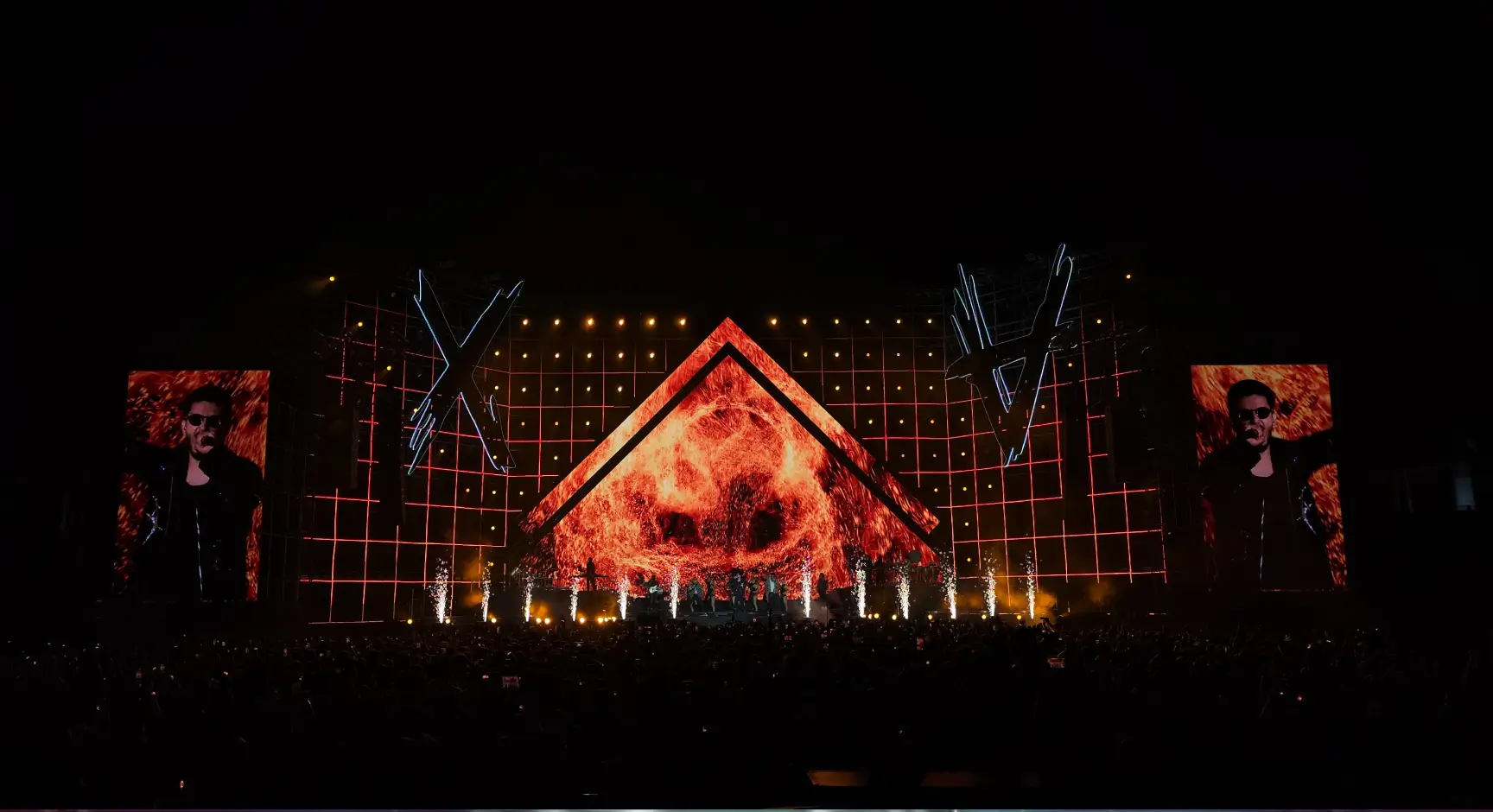
What if the stage itself could perform, moving, glowing and shifting shape right along with the artist on it?
That's the shift happening in live concert stage design right now. Screens have gotten sharper, projection has gotten precise enough to wrap an entire set, and real-time visual software lets a show change on the fly instead of running the same fixed backdrop every night. The set is no longer just decoration behind the artist, it's become part of the performance.
For most of live music history, stage design meant a painted backdrop, some trussing, and a lighting rig. That approach worked because the visuals were static and the show came from the performer.
Three things broke that model: LED walls became more accessible for large-scale productions, projection mapping got accurate enough to wrap curved and irregular set pieces, and real-time content software made it possible to change what's on screen mid-song instead of committing to one fixed loop. Put together, a stage can now react to the music instead of just sitting behind it.
A VJ (video jockey) is the person mixing and triggering visual content live, the visual equivalent of a DJ working a set. The role traces back to MTV in the 1980s, but on a modern concert stage it's grown into a full production discipline: pre-built video content gets layered, cut, and reacted to the music in real time, rather than just played on a loop.
This is where concert visuals earn their keep. A good VJ set makes the difference between a screen that's simply on and a screen that feels like it's responding to the song, brightening on a drop, cutting on a beat, or shifting colour with the mood of a track.
The technical skill matters, but what it's actually building is a feeling: a crowd that senses the show is reacting to them in real time, not just running a pre-set video behind the band. That's what turns a good concert into a memorable one, the visuals and the performance moving as one thing instead of two.
Watch it in action: Pixadoo YouTube Short — Live VJ Mixing
Most modern concert visual systems come down to four layers working together:
Most large concert productions end up using both, but they solve different problems. Here's the quick version:
| Aspect | LED Wall Backdrop | Projection-Mapped Stage |
|---|---|---|
| Best for | Bright, content-heavy screens: lyrics, IMAG, sponsor visuals | A hero moment: a set piece that seems to move or transform |
| Flexibility night to night | High, same rig, swap the content | Lower, content is built for that specific set |
| Daylight festival slots | Holds up well | Needs low light to read clearly |
| Feel on stage | A screen the artist stands in front of | A set the artist stands inside |
Which one's right for a given show usually comes down to a handful of practical factors: the stage design itself, lighting conditions on the day, how much content needs to be produced, and the kind of experience the show is going for. Most productions end up leaning on both rather than picking one over the other.
If you're planning a show and looking for event stage decoration ideas that go beyond backdrops and banners, a few approaches consistently work well, each aimed at a different kind of audience reaction:
Before locking a concept, it helps to have answers to a few practical questions:
Once those are clear, it's easier to tell whether a show needs LED, projection, or both. Pixadoo's Solutions Page goes through how each of those factors maps to a format, useful background before a first production call.
For a sense of what this looks like once it's built, The Tech Behind the Magic: Anirudh's XV Tour Live Intro breaks down how the visuals and VJ mixing came together for a full touring show, from planning through to the live set.
Stage design is the physical set: trussing, screens, projection surfaces and layout. Concert visuals are the content and live mixing that run on top of that set. You need both, but they're planned and built separately.
Most professional VJs work in real-time visual software such as Resolume or similar engines, which let them layer, blend and trigger video content live instead of playing a fixed loop, so the visuals can react to the set as it happens.
Yes. Instead of mapping a building, the surface is a stage set, backdrop or prop. It works especially well for a single transformative moment in a show, since it needs more lead time than a flat LED screen.
For a full LED and projection setup with custom content, 6 to 8 weeks is a safe minimum, since content design, VJ programming and on-site calibration all take time before a single show date.
Usually yes, since it needs a skilled operator and rehearsal time on top of the content itself. Fixed pre-rendered loops are cheaper but can't adapt if a setlist or song arrangement changes on the day.
Planning visuals for your next show? Talk to the Pixadoo team, we'll walk through what actually fits your stage, artist and budget, not just what looks impressive in a reel.